Maybe you train at home with a single pair of dumbbells. Maybe your gym is crowded and the dumbbell area is the only open corner. Maybe you just prefer keeping things simple. Whatever the reason, a workout built around dumbbells can be far more complete than people expect.
The secret is to think in movement patterns instead of individual gadgets. This guide walks through the main patterns you can train with dumbbells and shows a general example of how to put them together. It is educational, not an individualized prescription, and you should choose weights and exercises you can perform with control.
Limited Equipment Is Not a Limitation
Dumbbells are one of the most versatile tools in a gym. You can squat with them, hinge, press, row, raise, curl, extend, and carry, all with the same handful of weights. Many effective programs use little else.
What limits a dumbbell workout is usually not the equipment. It is knowing how to combine the movements so the whole body gets attention.
A single pair of adjustable dumbbells and a sturdy bench, or even just the floor, can cover a surprising amount. Space is rarely the issue, since most dumbbell movements need only a few square feet.
Think in Movement Patterns
Instead of collecting exercises, aim to cover a few basic patterns: squatting or lunging, hinging at the hips, pressing, rowing, shoulder work, and core. Each pattern has several dumbbell versions, so you can pick ones that suit your space and comfort.
Covering the patterns is more important than finding the perfect exercise for each. A balanced workout beats a clever one that leaves gaps.
Squat and Lunge Patterns
Goblet squats, where you hold one dumbbell at your chest, are a friendly place to start. Split squats, lunges, and step-ups add a single-leg challenge and can be done with a dumbbell in each hand.
Choose a weight you can hold comfortably and move with control. If balance is a challenge, start with a supported version or use your bodyweight first.
Reverse lunges, which step backward, are often easier to control than forward lunges for people who are new to them. Try both and keep the one that feels steadier.
Hinge Patterns
Hinging means bending at the hips while keeping your back neutral, and it works the back of your legs and your glutes. Dumbbell Romanian deadlifts and simple hip hinges are common examples. A glute bridge with a dumbbell resting on your hips is another option.
Hinges reward slow, controlled practice. Start light and focus on feeling the movement in the right places.
A helpful cue is to push your hips back as though closing a door with them, letting the dumbbells slide down your thighs while your back stays flat.
Pressing Patterns
Pressing exercises work your chest, shoulders, and triceps. A dumbbell floor press or bench press covers the horizontal push, and a standing or seated overhead press covers the vertical one. Push-ups fit here too and need no equipment at all.
If you do not have a bench, pressing from the floor is a workable substitute, and it also limits how far you can lower the weights.
Change the angle of a press slightly and you shift the emphasis, so an incline press leans more on the upper chest and shoulders. Keep your wrists stacked over your elbows.
Rowing Patterns
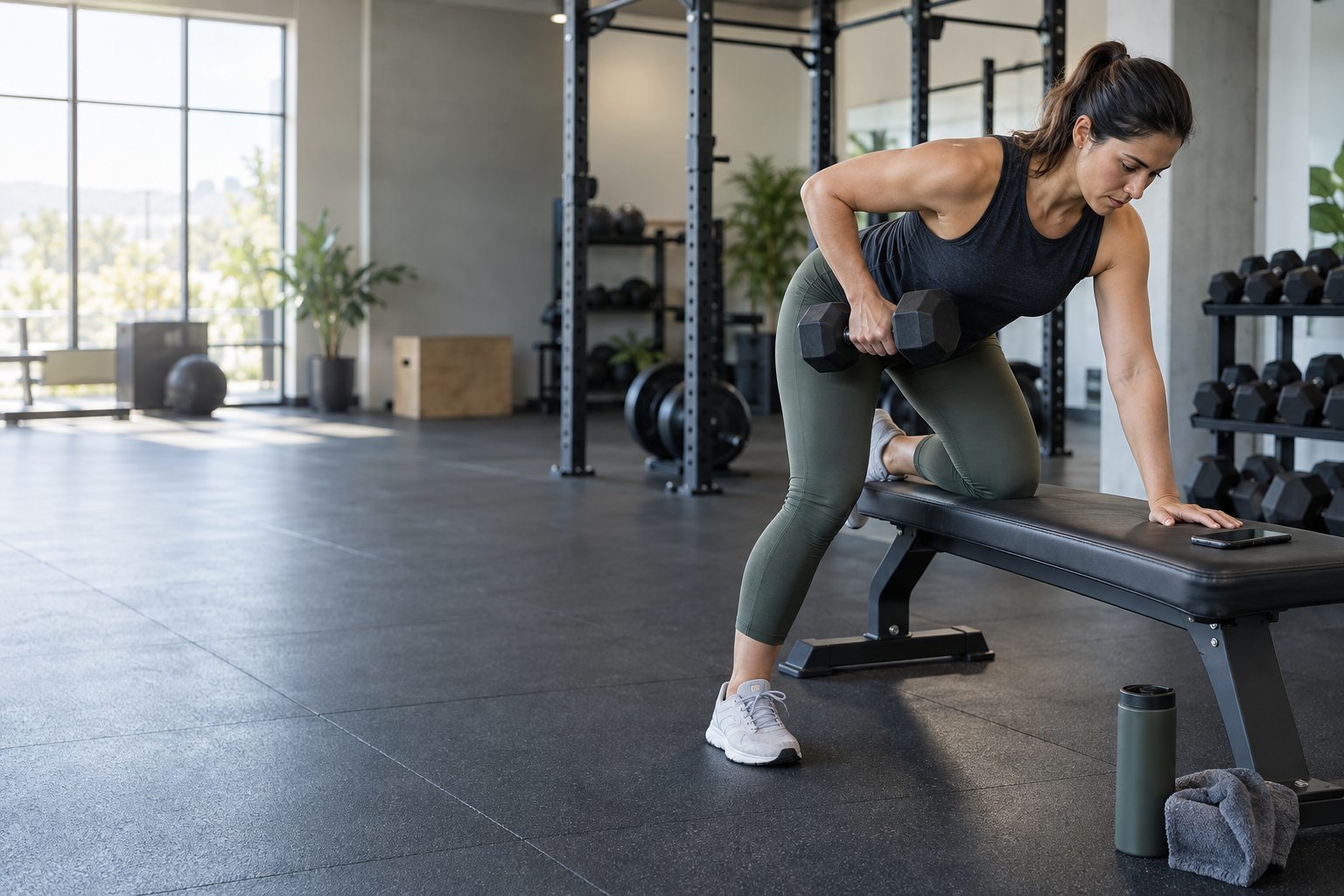
Rows train your upper back and the muscles that pull. One-arm rows with a hand on a bench or sturdy surface are popular because they let you focus on one side at a time. Chest-supported rows on an incline bench and bent-over rows are other choices.
Keep the movement smooth and avoid twisting. Pull toward your hip, pause briefly, and lower with control.
If a bench is not available, a hand on a sturdy chair can work, as long as it is stable and will not slide.
Shoulder Work, Arms, and Core
Lateral raises and rear raises add shoulder work that presses and rows do not cover fully. Curls and overhead triceps extensions round out the arms. Carrying a dumbbell in one hand while walking, often called a suitcase carry, challenges your core in a practical way.
These are supporting movements and usually fit at the end of a session, once the main patterns are done.
A General Example Workout
Here is one general example, not a prescription: a goblet squat, a dumbbell Romanian deadlift, a dumbbell press, a one-arm row, a lateral raise, and a carry. Doing a few sets of each with a moderate number of repetitions covers the main patterns in one session.
You could swap any exercise for another from the same pattern. Start with weights that leave you a few good repetitions in reserve, and adjust as you learn.
For the first sessions, two or three sets of each is plenty. As you get comfortable, you can add a set or an extra exercise, or replace one movement with a different variation.
Choosing and Progressing Weights
Adjustable dumbbells or a couple of pairs at different weights give you options, since some exercises call for heavier loads than others. If you only have one pair, you can still progress by adding repetitions, slowing the tempo, pausing at the hardest point, or moving to a tougher variation.
Our guide on how much weight a beginner should lift explains how to pick a manageable load and increase it gradually.
Make It Repeatable
A workout is only useful if you can repeat it. The exercise library in FitForgeFlow shows the equipment for each exercise, which makes it easier to find dumbbell movements, and you can build them into your own routine. Our comparison of premade workouts vs. creating your own can help you decide how to set it up.
If you are just starting, a beginner full-body workout is a good pattern to borrow, and our guide to machines vs. free weights explains how dumbbells fit into a bigger picture.