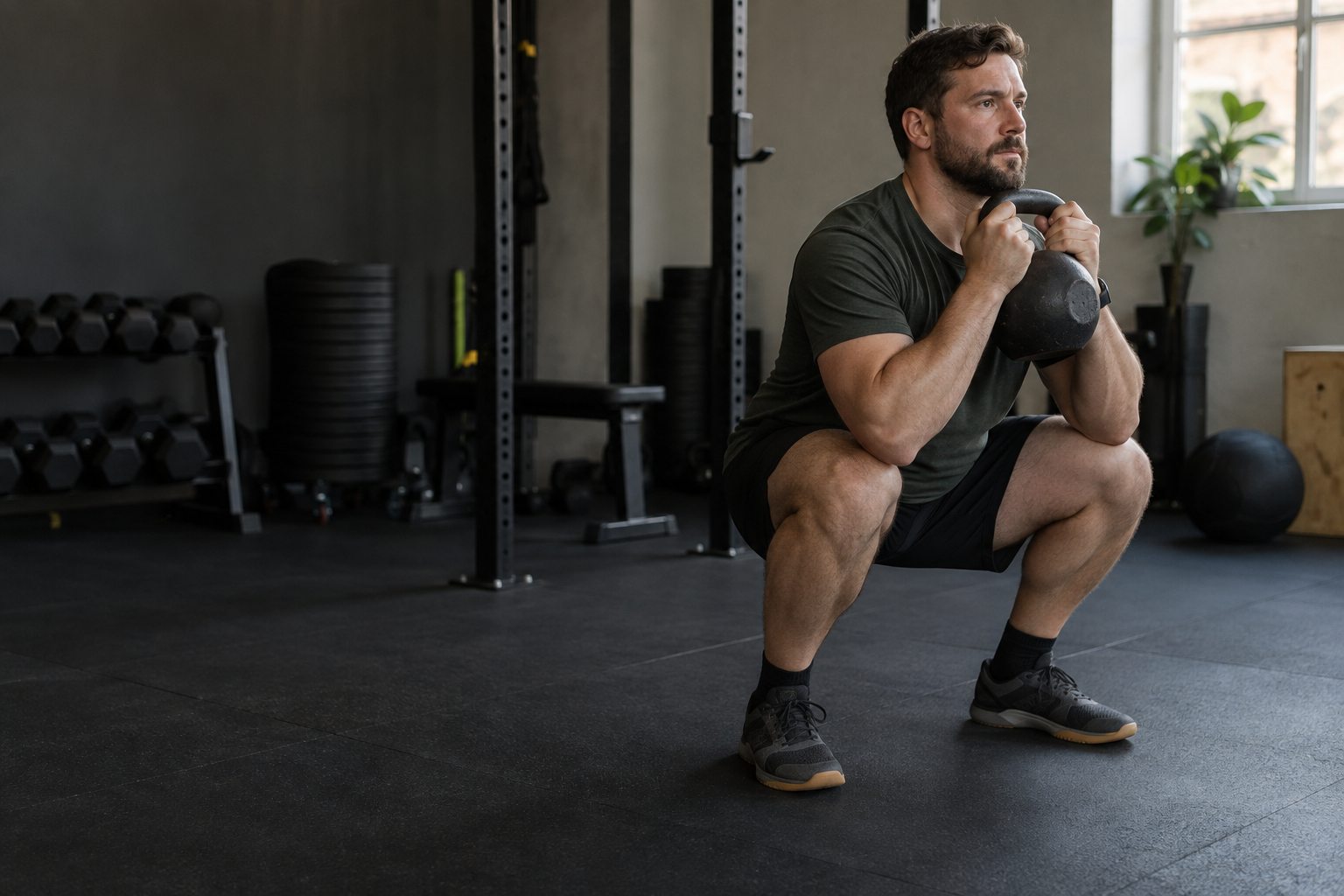
You settle on a weight, get into position, and then a small question stalls you before the first repetition: how many should you actually do? Eight? Twelve? Fifteen? The number feels like it should be exact, and most sources give a different answer.
Some of that disagreement comes from genuine differences between goals and exercises, and some of it is simply different authors expressing the same general idea in different words.
There is no single correct rep count for every beginner and every exercise. What matters is understanding how rep ranges work so you can choose sensibly instead of guessing. This guide explains that. It is general education, not an individualized or rehabilitation-specific prescription.
By the end, the goal is not to memorize a chart, but to understand the reasoning well enough to apply it to any exercise you try.
A Rep Range, Not a Rep Number
Rather than aiming for one exact repetition count, it helps to think in a range, such as eight to twelve. The range gives you room: on a good day you might reach the top, and on a harder day the bottom is still a fair result.
This flexibility matters for beginners especially, since your performance will vary while your body is still adjusting to regular training.
Even within a single week, your performance in a given range can shift with sleep, stress, and how recently you last trained that movement.
Different Exercises Tolerate Different Ranges
A heavy, demanding movement like a squat or a deadlift is often trained with a moderate range, such as six to ten, because the load and coordination required make very high repetitions impractical.
A lighter, more isolated exercise, such as a curl or a raise, often works well with a higher range, such as twelve to fifteen, since the smaller muscles involved recover quickly between reps.
This is a general tendency rather than a strict rule, and plenty of well-designed programs use ranges outside these examples for good reasons.
Moderate Ranges Are a Practical Place to Learn
For a beginner still learning a movement, a moderate range, often somewhere around eight to twelve repetitions, tends to be a comfortable place to start. It is high enough to build some familiarity with the exercise and low enough to keep the weight meaningful.
This is a practical starting point, not a rule. As you gain experience, your comfortable range for a given exercise may shift in either direction.
Some lifters eventually prefer lower ranges with heavier weight for certain exercises, while others stay comfortably in a moderate range indefinitely.
Technique Matters More Than Hitting a Number
A rep only counts for what it is worth if it is performed with reasonable control. Cutting the range of motion short, using momentum, or bouncing out of a position to reach a target number defeats the purpose of counting in the first place.
If you find yourself sacrificing form to hit a specific rep count, it is better to stop the set a repetition or two early and keep the movement honest.
A slightly lower rep count performed cleanly is more useful, over time, than a slightly higher one performed carelessly.
Load and Reps Interact
Weight and repetitions are connected. A heavier weight naturally limits how many good repetitions you can perform, and a lighter weight allows more. This is why a fixed number of reps means very little without knowing the weight behind it.
Our guide on how much weight a beginner should lift explains how to choose a starting load that fits a given rep range instead of picking the two separately.
Thinking of weight and reps as a single decision, rather than two unrelated choices, tends to produce a more sensible starting point.
Rep Targets Guide Weight Selection
Once you have a target range in mind, it becomes a useful check on your weight choice. If a weight lets you sail well past the top of your range with easy form, it is probably light for that exercise. If it stops you well short of the bottom, it is probably heavy.
Our article on more reps or more weight explains how to use this relationship to decide when to add load rather than just adding repetitions indefinitely.
At some point, adding more repetitions to the same weight stops being efficient, and a small increase in load becomes the more sensible next step.
Stopping When Technique Deteriorates
A rep range is a guide, not a demand to finish no matter what. If your form clearly breaks down before you reach the bottom of your intended range, that is more useful information than the number itself.
Over time, noticing this pattern for a specific exercise can tell you that your current weight is a touch too heavy for the range you are aiming for.
Stopping a set early because technique has slipped is a sign of good judgment, not a failure to complete the workout as planned.
Reps Are Not the Only Measure
Total sets, the exercises you choose, and how consistently you train all matter alongside repetitions. Our guide on how many sets to do per exercise rounds out the picture, since sets and reps together determine how much work a session actually involves.
Two workouts with identical rep counts can still involve very different amounts of total effort, depending on how many sets each one includes.
Focusing only on repetitions while ignoring everything else can give a misleading sense of how productive a workout was.
You Will Adjust as You Learn Your Body
The rep ranges in this guide are common starting points, not fixed rules. As you gain experience with a particular exercise, you may find you prefer a slightly different range, and that preference is valid as long as your technique stays sound.
Give any new range a few honest sessions before deciding it does or does not suit you. A single set is not enough information to judge.
Give a new approach at least a few sessions across a couple of weeks before deciding whether it suits the exercise better than what you were doing before.
Keep the Decision Simple
Pick a reasonable range for the exercise, choose a weight that challenges you within it, and keep your technique consistent from the first repetition to the last. That is a dependable approach for almost any beginner exercise.
The exact number matters far less than showing up, moving well, and doing it again next time.
That combination, repeated patiently, will do more for a beginner than any single rep target ever could on its own.