You arrive with a plan. The bench you need is occupied, the person on it has three dumbbells stacked beside them, and they do not look like they are leaving soon. You stand there, plan in hand, wondering whether to wait, skip the exercise, or abandon the workout.
The backup exercise rule prevents that stall. It is simple: before you need one, know a reasonable substitute for each important movement in your workout. This is general education, and it works within your own experience and abilities, so choose alternatives you can perform comfortably.
One Machine Should Not Control Your Workout
Most gyms get busy at predictable times, and popular equipment fills up first. If one occupied station derails your entire session, the plan is too fragile. A small amount of preparation turns a frustrating delay into a quick, calm switch.
This is also good for confidence. Knowing you have options makes a crowded gym feel manageable, which is part of what our guide on gym anxiety is about.
Keep the Goal, Change the Tool
The rule works because it focuses on the purpose of the exercise rather than the exact equipment. If the goal is a horizontal pressing movement for the chest, shoulders, and triceps, several tools can achieve it. If the goal is a squat pattern for the legs, there are many ways to train it.
Ask what the original exercise is trying to do, then choose another exercise that does something similar. It does not need to be identical, just a sensible match.
- Does it train a similar movement, such as pushing, pulling, squatting, or hinging?
- Does it work broadly the same muscles?
- Can I set it up and perform it comfortably with a weight I can control?
If the answer to all three is yes, you have a workable backup.
Horizontal Push Example
If the bench press is busy
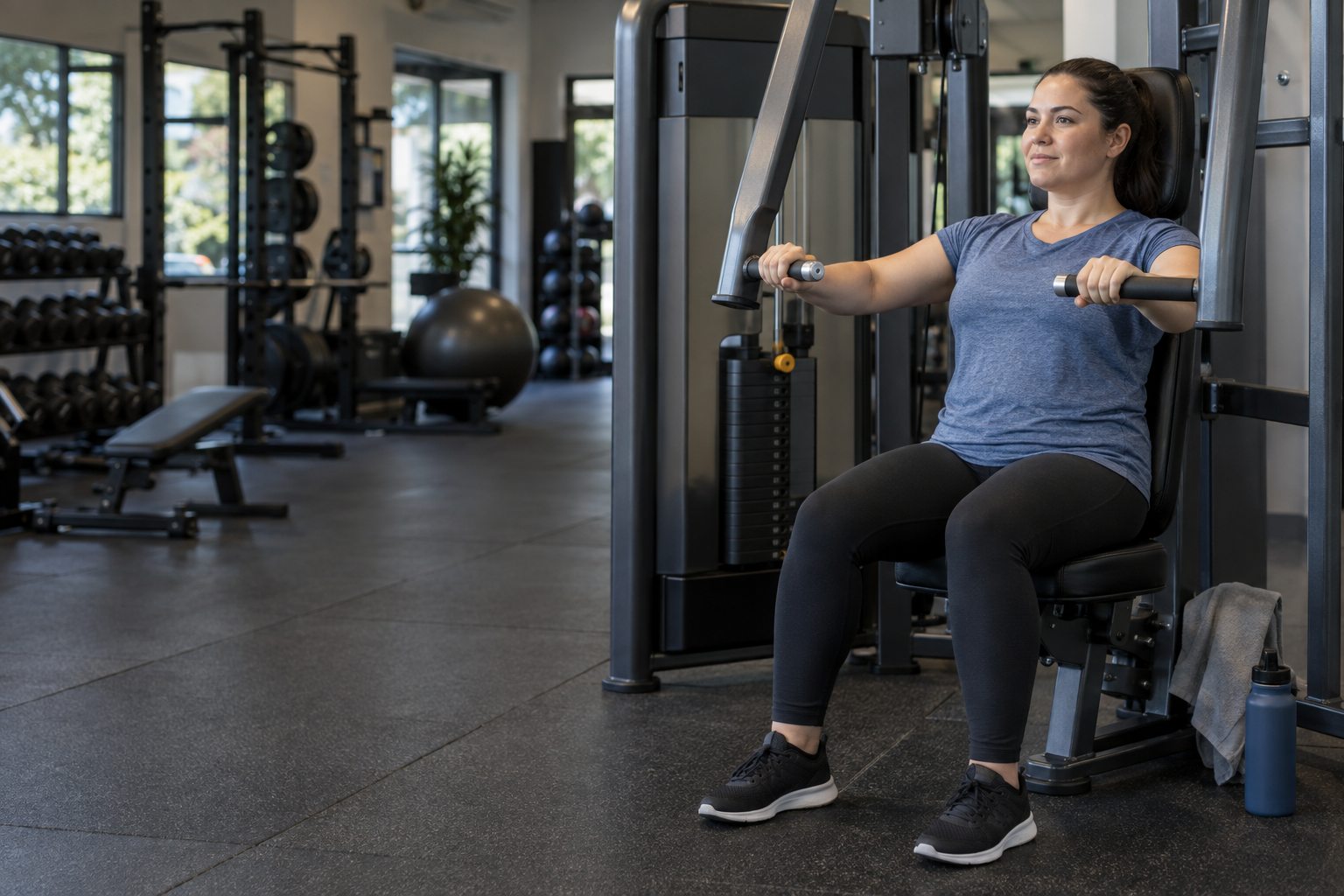
A dumbbell bench press, a machine chest press, a cable chest press, or a push-up variation all train a similar horizontal pressing pattern. If your gym has plenty of dumbbells, that may be the quickest switch.
Choose the option that feels stable and comfortable for you, and use a weight you can control.
Pulling Example
If the lat pulldown is busy
A seated cable row, a dumbbell row, a chest-supported row, or an assisted pull-up machine can all train pulling muscles in the back and arms. They do not work exactly the same way, but they are reasonable substitutes.
Vertical pulling and horizontal pulling are slightly different, so if possible, choose something close to the original movement and adjust in later workouts.
Leg Training Example
If the squat rack is taken
A goblet squat, leg press, split squat, or step-up can train similar muscles. For hinging patterns like Romanian deadlifts, dumbbell hip hinges, back extensions, or hip thrusts may fill the role.
Leg exercises can be demanding, so pick something you can do with good technique, warm up properly, and start with a manageable load.
Accessories Are Easy to Swap
Accessory exercises are generally the easiest to substitute. If the cable station for triceps pushdowns is busy, dumbbell triceps extensions or a bench dip variation may work. If the curl bar is missing, dumbbell curls do the same job.
- Triceps pushdown busy: dumbbell overhead triceps extension.
- Cable curl busy: dumbbell curl.
- Leg curl machine busy: a hamstring exercise with dumbbells, or another hamstring machine if available.
- Lateral raise station busy: dumbbell lateral raise.
Because accessories are meant to support the main lifts, a small change rarely affects the overall plan. This is a good place to practice flexibility.
When Not to Substitute
Not every switch is a good idea. If an exercise is specifically prescribed for a reason, such as by a coach or a rehabilitation plan, follow that guidance rather than swapping on your own. If a substitute feels unsafe or unfamiliar, skip it or ask for help.
And if an exercise causes sharp pain, stop, whatever the equipment. Persistent or concerning symptoms are best evaluated by a qualified professional.
Another time to hold off is when you are trying to compare progress on a specific lift. Swapping the exercise changes the comparison, so if you have been tracking one movement closely, it may be worth waiting a few minutes for it, or doing it later in the session, rather than replacing it.
Save Alternatives You Trust
Over time you will find swaps that work well for you. Keep a short list, whether on paper or in your phone, so you are not reinventing the plan each time. Having your favorites ready is the heart of the rule.
A simple format works: write each main exercise on the left and one or two trusted alternatives beside it. You might add a short note about the setup that suited you, such as a bench angle or a seat height. Five minutes of writing this down once can save you many minutes of standing around later.
In FitForgeFlow, when a workout supports editing, you can swap an exercise, add another, or remove one, and you can save your customized version to My Workouts. That makes it easier to keep the alternatives you like close at hand.
Avoid Random Exercise Hopping
The rule is about preparation, not endless variety. If you swap constantly, you lose the ability to track progress and compare sessions. Use backups when needed and return to your main exercises when they become available.
A helpful test is to ask whether the swap solves a real problem, like a busy station. If it does not, stick with the plan. Our guide on premade workouts vs. creating your own can help you decide how much to customize.
Flexibility Creates Flow
A workout that can bend without breaking is easier to keep doing. When you know your backups, a busy machine becomes a small detour instead of a roadblock, and your training keeps moving.
Before your next session, pick one backup for each main exercise. Then, when the crowd arrives, you will already know where to go. For more ideas, see what to do when the gym is crowded.