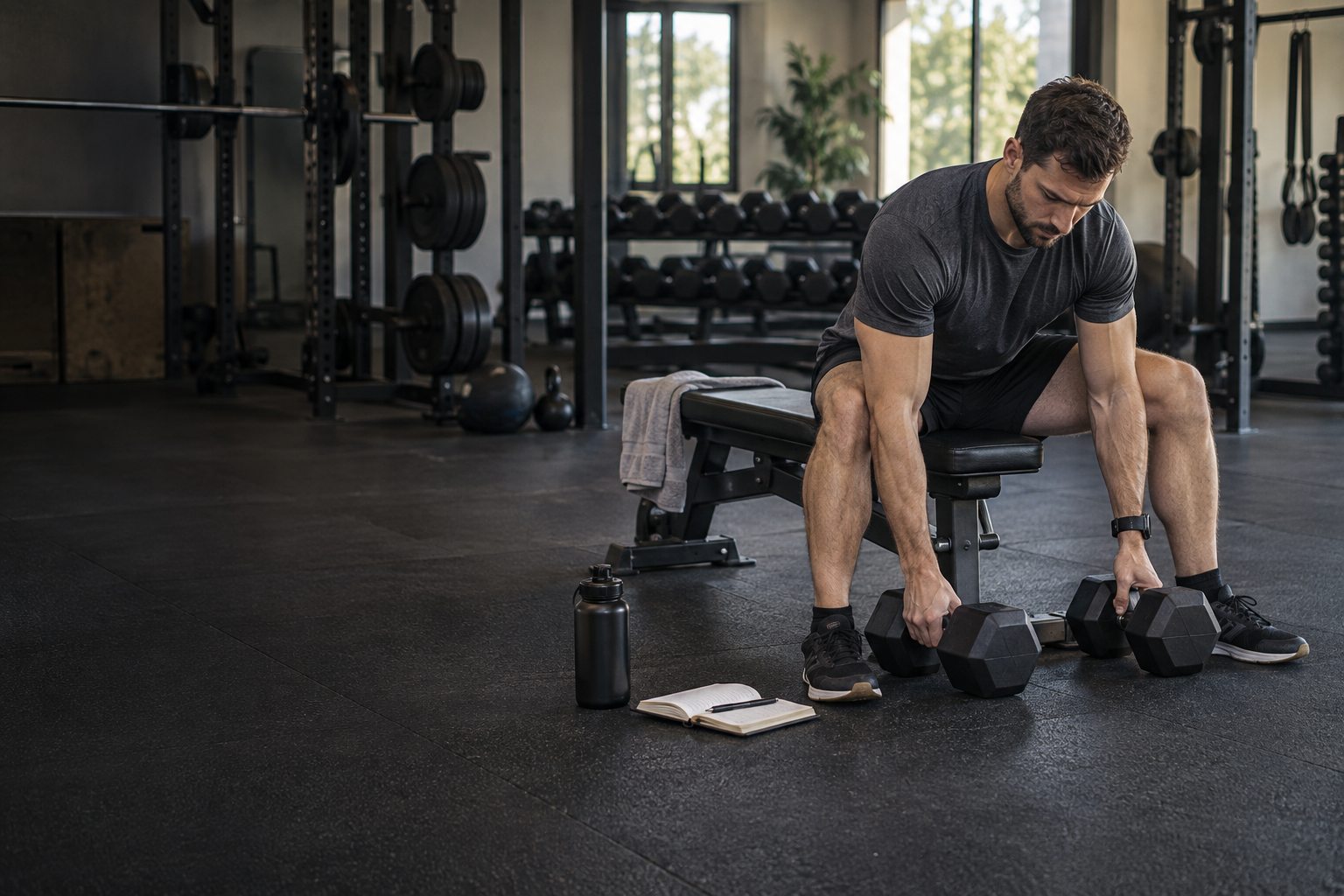
You finish a set, put the weight down, and then what? Some people stare at the wall. Some scroll through their phone until they forget which exercise they were on. Some rush back in before their breathing has settled. The minute or two between sets is a big part of any workout, yet most people never decide how to spend it.
This guide offers a simple way to use that time so it helps the next set instead of draining the session. It is general education, and your own needs, exercises, and experience will shape how long you rest and what you do.
Rest Is Preparation
The purpose of rest is to get you ready to perform the next set well. It is not empty time and it is not a race. Thinking of it as preparation gives you something useful to do with it, and it stops rest from either dragging on or being skipped.
If you are wondering how long to rest, our guide on how long to rest between sets covers that. This article is about what to do with the time you take.
Think of the gap as a short checklist rather than a pause: recover, record, plan, and prepare. Most of it takes only a few seconds, and it leaves you settled for the next set.
Breathe and Settle
The first job is simple: recover. Let your breathing settle and your heart rate come down. Stand or sit comfortably, take a few slow breaths, and let your body catch up with the effort you just made.
Slow breaths in through the nose and out through the mouth are an easy way to settle down. Walking a few steps can also help if you feel restless.
It sounds obvious, but many people cut this short. Starting the next set while still breathing hard can make it feel worse than it should.
Use a Timer if It Helps
A timer gives your rest a gentle edge. FitForgeFlow includes a built-in rest timer with quick presets from 15 to 90 seconds plus a custom option, and it can start when you log a set. Glancing at it tells you how long you have been resting without needing to count.
A timer is a tool, not a rule. Use it to keep rest from drifting, and feel free to take a bit longer when a hard set warrants it.
It can also help when you tend to rush. Seeing the countdown reminds you that the rest is part of the plan, not a delay.
Log the Set You Just Finished
Between sets is the natural time to record what you just did. Enter the weight and repetitions while they are fresh, and add a quick note if something is worth remembering. FitForgeFlow lets you log each set this way, and it pre-fills the next set from the one you just completed.
Logging while you rest costs almost no extra time, and it means you never have to reconstruct the workout from memory afterward.
Review the Next Load
Use a few seconds to decide whether the next set should stay the same, go up, or come down. If the last set felt very easy, or was a struggle, that is useful information. Adjusting between sets is a normal part of learning what suits you.
If you change the weight, FitForgeFlow can carry that adjustment toward your next scheduled workout that includes the exercise, so the change is not forgotten.
Prepare Your Equipment
Rest is a good moment for small setup tasks: adjust the pin on a weight stack, change the bench angle, pick up the dumbbells you will use next, or check the rack height. Doing this while resting means the next set starts immediately when you are ready.
It also helps in a busy gym, where being prepared can keep you from losing a piece of equipment to someone else.
Do a Quick Form Check
Think back over the set. Did the movement stay controlled? Was there a moment where your form slipped? A single technique cue for the next set, such as keeping your chest up or controlling the way down, is more useful than trying to fix everything at once.
If you are unsure about a movement, the instructions and form cues in the exercise library at FitForgeFlow can remind you what to focus on.
Keep the Phone in Its Place
Your phone can help you during a workout, especially if it holds your plan or timer. It can also swallow several minutes of rest without you noticing. The trick is to use it for the workout and set it aside for everything else.
If you find yourself opening unrelated apps between sets, try leaving notifications off, or moving the phone out of reach until it is time to log or check the timer.
If you use your phone to log sets, open the app, enter the numbers, and then put the phone down until the timer finishes.
Do Not Rush Either
Cutting rest short to finish sooner can make your next set worse, and the workout can end up feeling harder than it needs to. Speed is not a measure of quality. If you want a shorter workout, trim the exercise list, not the recovery that keeps your sets good.
Our guide on how long a gym workout should be explains how to shorten a session without rushing every set.
A Simple Between-Sets Routine
Try this: breathe, log the set, decide the next weight, prepare your equipment, and start when you are ready. It takes very little effort, and it means every minute of rest has a job.
Over time the routine becomes automatic, and your log builds itself. That is what the habit of logging your workouts is meant to do: make the next set, and the next workout, easier.
On heavier or more demanding exercises you may want extra time, and on lighter accessory work you may need less. The routine stays the same either way.