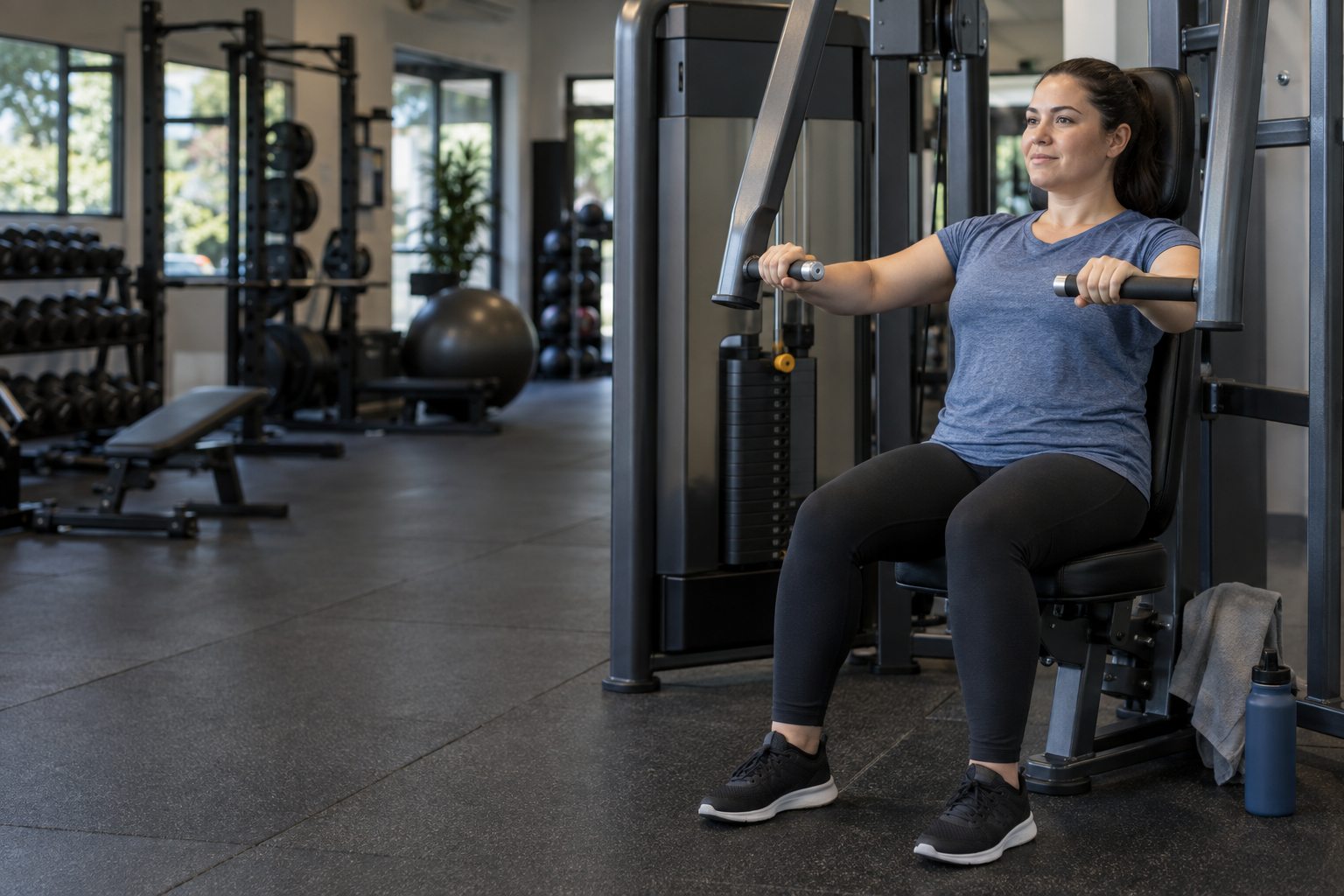
You show up ready to follow a workout you found somewhere, and the exact machine it calls for either does not exist at your gym or is occupied by someone clearly settling in for a while. If your workout is built around one specific piece of equipment, that is exactly the moment it falls apart.
It is a frustrating way to start a session, and it is entirely avoidable with a small shift in how you plan.
A more durable approach is to build workouts around movement goals rather than specific machines, so almost any gym's equipment can fill in the details. This guide explains how. It is general education, not an individualized plan.
The approach below works whether you train at a large commercial gym, a small studio, or a modest home setup.
Plan the Movement, Not the Machine
Instead of writing down a specific named machine, think in terms of what you want to accomplish: a push, a pull, a squat or lunge, a hinge, and some core work. Nearly every gym has some way to train each of these patterns.
This shift makes your plan portable. A gym with different equipment, or a busy one where your first choice is unavailable, no longer derails the whole workout.
It also makes trying a new gym, whether while traveling or just visiting a friend's, far less stressful.
Push
Pushing movements train the chest, shoulders, and triceps. A barbell bench press, a dumbbell press, a chest press machine, a cable press, or even push-ups can all fill this role depending on what is available.
If your usual pushing exercise is taken, look for any of these alternatives rather than skipping the pattern entirely.
Even a resistance band, if that is all that is available, can serve as a temporary pushing option in a pinch.
Pull
Pulling movements train the back and biceps. Options include a lat pulldown, a seated row machine, a cable row, a dumbbell row, or a pull-up if your gym has a bar.
Because there are usually several pulling options in a gym, this pattern is often the easiest to substitute for.
If your gym has any cable station at all, it can usually cover this pattern in some form.
Squat or Lunge
This pattern trains the legs through bending at the knees and hips. A barbell squat, a leg press, a goblet squat with a dumbbell, or a lunge variation can all serve, depending on the rack and machine situation.
A pair of heavy dumbbells held at your sides for a loaded carry can even serve as a stand-in when nothing else is free.
If the squat rack is busy, a leg press or a dumbbell goblet squat can substitute without losing the pattern.
Hinge
Hinging trains the back of the legs and the glutes through bending mainly at the hips. A barbell or dumbbell Romanian deadlift, a hip thrust, or a machine hip extension all work here.
This pattern is sometimes the easiest to overlook, so it is worth deliberately including a hinge option in your plan rather than assuming your squat work covers it.
Many beginners skip this pattern simply because it is less familiar than squatting, so it deserves a deliberate spot on the list.
Core
Core work can come from planks, cable or machine rotation exercises, weighted carries, or simple floor exercises that need no equipment at all. This is usually the pattern with the fewest equipment constraints.
If nothing else is free, bodyweight core exercises are almost always an option, which makes this a reliable way to finish a session.
Because this pattern rarely requires waiting for equipment, it is a convenient one to schedule at the very end of a busy session.
Keep a Backup in Mind for Each Pattern
Before you even get to the gym, think of one backup exercise for each pattern you plan to train. If your first choice is unavailable, you already know what to do instead.
This is the idea behind the backup exercise rule: a small amount of planning ahead of time saves a lot of frustration in the moment.
Even a mental note, rather than a written one, is enough to prevent a busy gym from throwing off your whole plan.
Adapting on a Busy Day
If the gym is unusually crowded, be willing to reorder your workout, doing whatever pattern has open equipment first and coming back to the rest later. Our guide on what to do when the gym is crowded covers more ways to keep a session moving despite the wait.
Flexibility in order and exercise choice, while keeping the same underlying patterns, lets a crowded gym slow you down without stopping you.
Treat a busy gym as a scheduling puzzle rather than an obstacle. There is almost always a way to get a full session in with a little flexibility.
Build the Plan Once, Reuse It Anywhere
Once you have a movement-based plan, it works at your home gym, a hotel gym on a trip, or a friend's gym you are visiting for the first time. You are no longer tied to one specific layout of equipment.
Our guide on choosing the right premade workout can help you pick a structure that is easy to adapt this way.
A plan built around patterns rather than specific machines also ages well, since it keeps working even as a gym's equipment changes over time.
Let the Exercise Library Help You Substitute
The FitForgeFlow exercise library shows the equipment each exercise uses, which makes it easier to spot alternatives for a given movement pattern on the fly. Where a workout supports editing, you can swap exercises to match what is actually available that day.
Building around patterns instead of specific equipment means a busy gym, a different location, or a piece of broken equipment is an inconvenience, not a reason to skip the workout.
That flexibility is ultimately what keeps a routine going for months and years, long after the excitement of a new plan has faded.